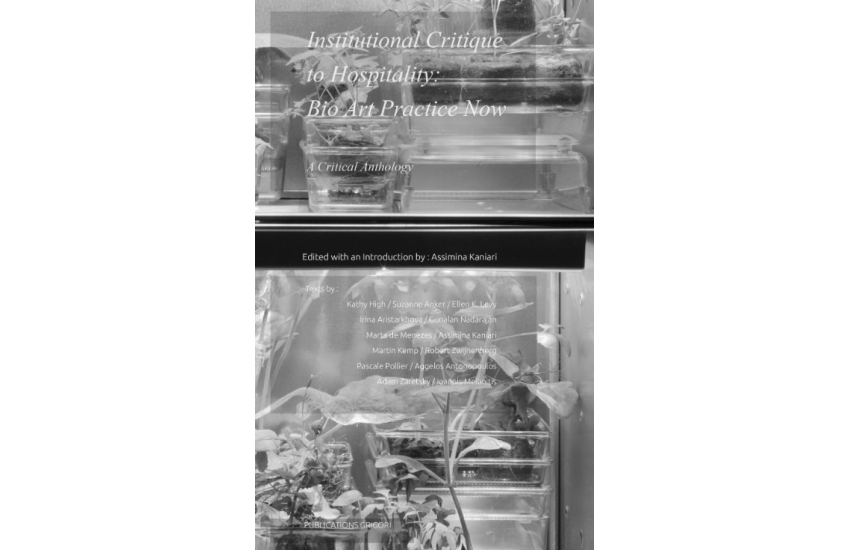
Institutional Critique to Hospitality: Bio Art Practice Now brings together 13 texts by renowned art historians, art theorists and pioneering artists considering bio art's contemporary relevance.
The first part of the book charts a transition in contemporary bio art practice concerned with a move away from Institutional critique into the idea of Hospitality: Kathy High provides an endearing account of 'Bees and Microbes', while Suzanne Anker reflects on "Three Blind Mice'. Marta de Menezes rethinks 'Representation in Bio art' while Pascale Pollier considers 'The Fabric of Life' with regard to "Fabrica Fitae" exhibition and Aggelos Antonopoulos makes a personal statement with regard to his own contribution to this exhibition. Ellen K. Levy thinks about 'Emergence' in the context of bio art, while Adam Zaretsky provides a critical commentary on contemporary artists' engagement with bio art and loannis Melanitis an autobiographical one.
In the second part of the book, the tension between these two notions and contexts is examined in a historical light: Martin Kemp discusses 'Pros and a few Cons' for ,'Artists in Labs', while Assimina Kaniari considers early precedences of bio artists' gestures in Leonardo's "Trattato". Robert Zwijnenberg examines the affinities between 'Xenotransfusion and Art', Gunalan Nadarajan writes on 'Specters of the Animal' "and Irina Aristarkhova considers 'the Art of Kathy High' as a form of hospitality.
The introduction to the anthology examines Institutional critique and Hospitality as ways of looking at and making sense of bio art today, but also as notions charting and accounting for transitions in art history in terms of artists' engagement with living media - whether on a literal or metaphorical level.